
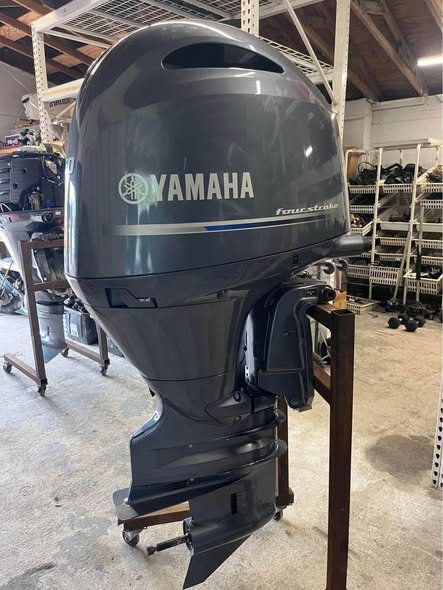
Yamaha F150 Outboard Motor – 150HP 4-Stroke Marine Engine
The Yamaha F150 Outboard Motor is a proven 150HP four-stroke marine engine designed for fishing boats, center consoles, bay boats, pontoons, runabouts and repower applications.
With Yamaha’s inline four-cylinder platform, electronic fuel injection and a broad range of mechanical and digital-control configurations, the Yamaha F150 Outboard Motor gives boat owners a versatile option in one of the marine industry’s most popular horsepower classes.
Whether you’re replacing an older two-stroke, building a fishing boat or upgrading an existing propulsion system, the F150 combines 150HP performance with modern four-stroke technology and Yamaha’s established marine-engine platform.
Browse our complete Yamaha Outboard Motors range or compare this engine with other 4-Stroke Outboard Motors.
Why Choose the Yamaha F150 Outboard Motor?
The Yamaha F150 Outboard Motor sits in a particularly useful horsepower range.
A properly matched 150HP engine can provide an effective balance between performance, weight and operating requirements for many medium-size recreational and fishing boats.
Key F150 characteristics include:
- 150HP four-stroke power
- Inline four-cylinder architecture
- Electronic Fuel Injection (EFI)
- DOHC design
- 5,000–6,000 RPM full-throttle operating range
- 2.00:1 gear ratio
- Electric starting
- Power trim and tilt
- Mechanical and Digital Electronic Control configurations
- 20-inch and 25-inch shaft configurations depending on model
- Compatibility with numerous recreational and fishing applications
Current Yamaha specifications show important differences between F150 configurations, including 2.7L mechanical-control versions and 2.8L Digital Electronic Control (DEC) versions. Buyers should therefore verify the exact model number before ordering.
Yamaha F150 150HP Four-Stroke Performance
The Yamaha F150 Outboard Motor uses an inline four-cylinder configuration designed to deliver smooth power across the operating range.
Electronic Fuel Injection meters fuel according to engine operating conditions, while the DOHC cylinder-head design supports efficient airflow.
For boat owners, this makes the F150 suitable for applications requiring a combination of low-speed maneuverability, cruising performance and full-throttle power.
Actual boat performance will depend on several factors, including:
- Hull design
- Boat weight
- Passenger load
- Fuel load
- Propeller selection
- Engine mounting height
- Water conditions
- Trim
- Bottom condition
Yamaha’s own performance testing demonstrates this variation. For example, Yamaha tested a 2.7L F150 on an 18’11” Starcraft 191 SVX with a total tested weight of 3,684 lb, illustrating why engine performance needs to be considered as part of the complete boat package rather than horsepower alone.
Electronic Fuel Injection
The Yamaha F150 Outboard Motor uses Electronic Fuel Injection rather than a traditional carburetor system.
EFI helps manage fuel delivery according to engine requirements and contributes to predictable starting and throttle operation.
Fuel economy in real-world boating, however, is determined by more than the engine itself.
Boat weight, propeller selection, RPM, sea conditions and hull efficiency can substantially influence consumption.
For buyers comparing manufacturers within this horsepower range, see our Best 150HP Outboard Motor: Yamaha vs Mercury vs Suzuki vs Honda.
Yamaha F150 Specifications
Because Yamaha currently offers different F150 configurations, specifications should be confirmed against the exact model number being purchased.
| Specification | Yamaha F150 |
|---|---|
| Horsepower | 150 HP |
| Engine Type | Inline 4, Four-Stroke |
| Fuel Induction | Electronic Fuel Injection (EFI) |
| Displacement | 2.7L mechanical / 2.8L DEC, depending on model |
| Full Throttle RPM | 5,000–6,000 RPM |
| Prop Shaft Horsepower | 150 HP @ 5,500 RPM |
| Gear Ratio | 2.00:1 |
| Starting | Electric |
| Gear Shift | Forward-Neutral-Reverse |
| Exhaust | Through propeller |
| Shaft Options | 20″ / 25″, depending on configuration |
| Controls | Mechanical or DEC, depending on model |
| Alternator Output at W.O.T. | 35A / 50A depending on configuration |
| Power Trim & Tilt | Yes |
| Recommended Fuel | Depends on configuration; verify exact model |
| Ethanol Blend Limit | Maximum E10 |
These figures reflect Yamaha’s current F150 family specifications and demonstrate why an exact model designation is important.
Mechanical vs Digital Yamaha F150
One particularly important consideration when buying a Yamaha F150 Outboard Motor is the control configuration.
Current Yamaha listings include mechanical-control and Digital Electronic Control versions. Yamaha’s July 2026 model information, for example, lists mechanical F150 models alongside 2.8L DEC versions such as the F150XSA.
This distinction matters when repowering because controls, wiring, gauges and other rigging may differ.
If you’re replacing an existing Yamaha engine, do not assume your current controls will automatically work with every F150 configuration.
Confirm compatibility before purchase.
Yamaha F150 for Fishing Boats
The Yamaha F150 Outboard Motor can be an attractive choice for fishing boats approved for this horsepower and engine weight.
Fishing-boat buyers should consider more than maximum speed.
Important factors include:
- Cruising efficiency
- Low-speed operation
- Charging requirements
- Fuel capacity
- Engine weight
- Corrosion protection
- Service access
- Propeller selection
Modern fishing boats may operate multiple electrical accessories, including chartplotters, fish finders, radios, pumps and livewell equipment. The charging requirements of the complete boat should therefore be considered when selecting an F150 configuration.
Read our Best Outboard Motor for Fishing Boats guide for more help matching horsepower to fishing applications.
Yamaha F150 for Repowering
The Yamaha F150 Outboard Motor is also worth considering when repowering a boat previously fitted with an older 150HP engine.
But equal horsepower does not guarantee a direct replacement.
Before repowering, verify:
- Maximum transom horsepower
- Maximum acceptable engine weight
- Shaft length
- Existing steering
- Control compatibility
- Gauges
- Wiring
- Fuel system
- Battery requirements
- Propeller selection
- Mounting configuration
This becomes especially important when replacing an older two-stroke with a modern four-stroke.
Read our How to Repower a Small Fishing Boat before selecting your replacement engine.
Yamaha F150 Weight
Weight is another area where buyers need to identify the exact F150 configuration.
Older Yamaha performance data for the F150LB shows an estimated engine weight of approximately 478 lb, while Yamaha’s current F150 family specifications list higher weights for current mechanical and DEC configurations.
Therefore, do not use 478 lb as a universal weight for every Yamaha F150.
The exact model, shaft length, control configuration and generation matter.
This is particularly important during a repower because additional stern weight can affect:
- Static trim
- Draft
- Hole shot
- Planing characteristics
- Transom loading
- Overall boat balance
Choosing the Correct Shaft Length
The Yamaha F150 Outboard Motor is available in different shaft configurations depending on model.
Current Yamaha specifications list 20-inch and 25-inch options within the F150 family.
The correct shaft length depends on your boat’s transom and installation requirements.
Never choose shaft length simply because another boat looks similar.
An incorrectly matched engine installation can affect propeller immersion, handling and performance.
2-Stroke to Yamaha F150 4-Stroke Repower
Many boat owners considering a Yamaha F150 are replacing an older 150HP two-stroke.
Modern four-stroke technology offers different operating characteristics, but weight and rigging need careful consideration during the conversion.
If you’re still deciding between the technologies, read our 2 Stroke vs 4 Stroke Outboard Motors: Which Is Better in 2026?.
You can also compare our 2-Stroke Outboards and 4-Stroke Outboards.
Yamaha F150 Maintenance
Regular maintenance is essential to protecting any marine engine.
Owners should follow the maintenance schedule specified for their exact Yamaha F150 model.
Typical maintenance areas include:
- Engine oil
- Oil filter
- Gearcase lubricant
- Fuel filtration
- Spark plugs
- Cooling system
- Water-pump components
- Sacrificial anodes
- Propeller and propeller shaft
- Battery and electrical connections
- Corrosion inspection
Saltwater operation makes flushing and corrosion inspection particularly important.
For the most accurate maintenance intervals, fluid specifications and procedures, use the manual corresponding to the engine’s exact model and serial number.
For manufacturer specifications and documentation, consult Yamaha Outboards.
Yamaha F150 vs Other 150HP Outboards
Before purchasing, it can be worthwhile comparing the Yamaha F150 with competing 150HP engines.
Important comparison points include:
- Engine architecture
- Displacement
- Weight
- Controls
- Shaft options
- Gear ratio
- Charging capability
- Local servicing
- Parts availability
- Warranty
- Total installed cost
Our 150HP outboard comparison examines Yamaha, Mercury, Suzuki and Honda options in greater detail.
You can also browse our Mercury Outboard Motors, Suzuki Outboard Motors and Honda Outboard Motors if you’re still comparing brands.
Ordering a Yamaha F150 Outboard Motor
Before ordering a Yamaha F150 Outboard Motor, confirm the exact engine configuration required for your boat.
Important information includes:
- Boat make and model
- Maximum horsepower rating
- Transom height
- Desired shaft length
- Mechanical or digital controls
- Single or multiple-engine installation
- Existing steering system
- Current rigging
- Delivery destination
Confirming these details before purchase helps reduce the risk of ordering an incompatible configuration.
For delivery information, see our Shipping & Freight Policy.
For coverage applicable to your purchase, review our Warranty Policy.
If you need help determining the appropriate configuration, contact Amitag Outboards before ordering.
Frequently Asked Questions
Is the Yamaha F150 Outboard Motor a 4-stroke?
Yes. The Yamaha F150 is a four-stroke inline four-cylinder outboard.
How much horsepower does the Yamaha F150 produce?
The F150 is rated at 150 prop-shaft horsepower at 5,500 RPM according to Yamaha’s current specifications.
Is the Yamaha F150 2.7L or 2.8L?
It depends on the configuration. Yamaha currently lists a 2.7L mechanical F150 and a 2.8L DEC F150, so buyers should verify the exact model rather than assuming all F150 engines have identical displacement.
Is the Yamaha F150 available with digital controls?
Yes. Yamaha currently lists Digital Electronic Control F150 configurations as well as mechanical-control versions.
What shaft lengths are available for the Yamaha F150?
Yamaha’s current F150 family includes 20-inch and 25-inch shaft configurations, depending on the specific model.
What fuel does the Yamaha F150 require?
Fuel recommendation depends on the F150 configuration. Yamaha currently lists different minimum octane recommendations across the mechanical and DEC versions, so follow the specification for your exact engine.
What is the Yamaha F150 gear ratio?
Yamaha currently specifies a 2.00:1 gear ratio for the F150 family.
Can I replace an older 150HP two-stroke with a Yamaha F150?
Potentially, provided your boat can accommodate the engine’s weight and installation requirements. Verify transom capacity, shaft length, steering, controls, wiring and rigging before purchasing.
Is the Yamaha F150 suitable for saltwater?
The F150 is used in marine applications including saltwater operation, but proper flushing, anode inspection and scheduled maintenance remain important.
Can the Yamaha F150 be used in twin-engine installations?
Certain F150 configurations can be used in multiple-engine installations. Yamaha publishes performance data for twin F150 applications, including current 2.8L DEC installations.
Buy Yamaha F150 Outboard Motor
The Yamaha F150 Outboard Motor provides 150HP four-stroke power for boat owners seeking a versatile engine for fishing, cruising or repowering.
The key is selecting the correct F150 configuration rather than purchasing on horsepower alone.
Verify the model, shaft length, controls, engine weight and rigging requirements for your boat before ordering.
Browse more Yamaha Outboard Motors or explore our complete Outboard Engines range.
Product specifications may vary by model, configuration, market and model year. Confirm the exact engine specifications and compatibility before purchase.



Reviews
There are no reviews yet.